Community Corner
Fields of Cannabis in Old Brooklyn
Revisting a long-forgotten — and local — war on drugs.

There was a time in Brooklyn’s history when marijuana plants as tall as Christmas trees grew out in the open in vacant lots across the borough. From Avenue X to the banks of Newtown Creek, the plants grew in what a Brooklyn Eagle reporter described in 1951 as “lush impudence.”
This forgotten botanical history was recently unearthed by Ben Gocker, a librarian at the Brooklyn Public Library’s Brooklyn Collection. While searching through the archives for a patron, he found a folder marked “Crime: Drugs: Marijuana.”
It turns out the green stuff was growing all over Brooklyn, including around the Gowanus Canal. Many residents had it in their yards, and didn't even know it.
Find out what's happening in Carroll Gardens-Cobble Hillwith free, real-time updates from Patch.
“I wondered why we had so many photos just on this topic,” said Gocker, who recently wrote about his findings on the collection’s blog, Brooklynology. “I just kind of dug around in the morgue and found newspaper clippings, and it turned out that there was this big citywide effort to uproot all this pot that was growing wildly.”
Marijuana “plantations,” both wild and cultivated, became the target of massive raids by the Department of Sanitation and the NYPD, who sought to eradicate the narcotic growth, said Gocker. In the summer of 1951, sanitation workers dug up and incinerated 41,000 pounds of marijuana from 274 lots around the city. Queens produced the largest crop, at 17,445 pounds, while Brooklyn was a close second, with 17,200 pounds.
Find out what's happening in Carroll Gardens-Cobble Hillwith free, real-time updates from Patch.
The New Yorker magazine accompanied Department of Sanitation Chief Inspector John E. Gleason on one of his Brooklyn sweeps for an article in its August 11, 1951 issue.
“We can’t hope to wipe it out entirely,” Gleason told the magazine’s reporter. “A lot of it is planted, but the weed grows freely here, and most of the marijuana in the city is probably in the back yards of people who don’t know what it is, and therefore don’t report it. Each plant bears clusters of seeds that are blown away by the wind and sprout elsewhere.”
Somewhat less convincingly, an NYPD narcotics squad spokesman told a Brooklyn Eagle reporter in 1947 that “the weed is liable to pop up wherever flaxseed is fed to pigeons and wherever it falls on fertile soil.”
That same article describes a mile-long stretch along Newtown Creek where the weeds were thriving. Local factory owners had complained to their police precinct about the growth, fearing that its consumers “might go berserk and break into the factories.” Locals also reported “crazed” cats and dogs roaming the area.
Downtown Brooklyn saw its share of illegal agriculture, too. In 1951, a bold band of farmers cultivated a 300-pound patch in the middle of the building site for a new Civic Center, according to the Brooklyn Eagle. The following summer, a crop was found growing right beside the Brooklyn Federal Building, a block north of Tillary Street.
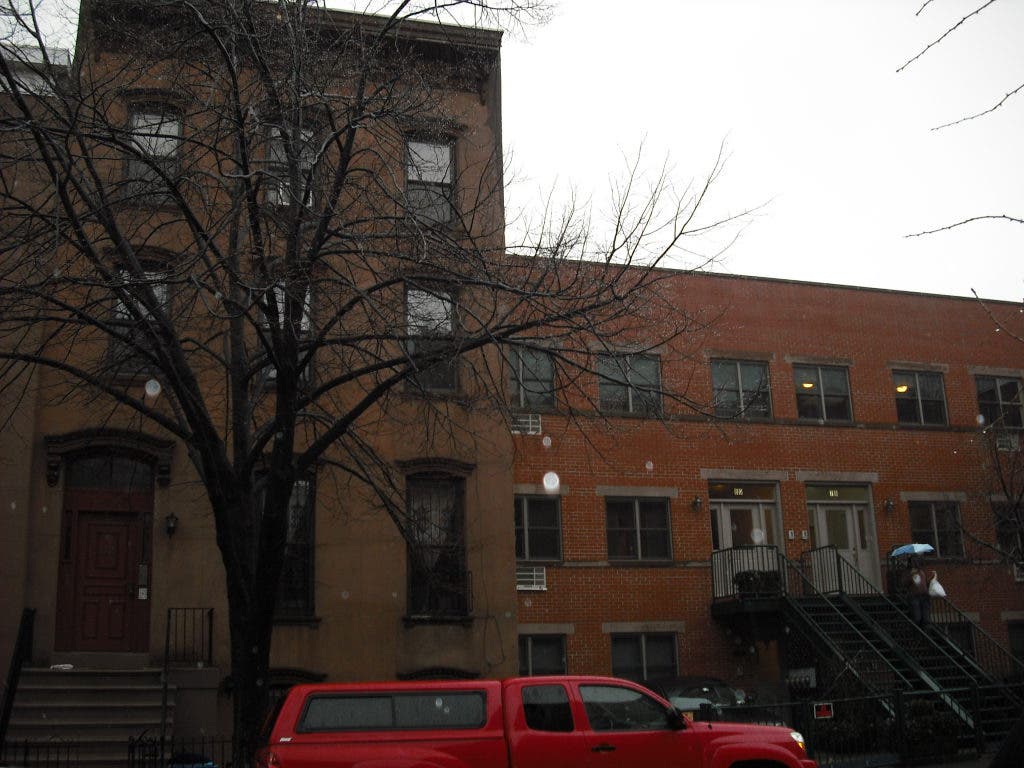
On August 22, 1953, New York City police removed a crop of 100 pounds of marijuana growing in an empty lot at 82 Butler Street. The lot, located between Hoyt and Smith Street, is now apartment buildings. A recent inspection of the area yielded no stray flora of that kind.
Long-time Carroll Gardens resident Buddy Scotto is not surprised by this piece of history, though he said he only heard rumors about it at the time.
“The rumors were that there were all kinds of illegal activities going on in and around the Gowanus Canal,” he said.
“The factories were abandoned, so nobody was down there and the place was pretty much deserted. That gave rise to all kinds of crazy rumors, but the stench of the canal reinforced the fact that who the hell wants to go down there and who cares?”
The DOS did care, apparently. Another Eagle article from 1951 carefully describes the leaves of the marijuana plant and concludes: “If you spot these leaves in your back yard, growing in a tall, erect stalk, you have a budding marijuana crop on tap and the Sanitation Department would like to know about it.”
While wild Cannabis sativa doesn’t appear to be growing in quite the same abundance as it once had, it continues to make occasional appearances.
Afterall, it was just last June that a stray marijuana plant was found peeping out of a hedge in Ditmas Park.
